


Reducing radiation exposure in endodontics
Featured Products Promotional FeaturesPosted by: Dental Design 22nd October 2023
In preparation for endodontic treatment, clinicians are required to take radiographic images to establish the length of the root canals. During treatment, this is used to locate the apex. As dental technology continues to develop, electronic apex locators have proved a useful aid for locating the apex during root canal treatment. While radiographs are still essential for diagnosis and treatment planning purposes, could electronic apex locators present a way to reduce patients’ exposure to radiation?
Radiography in endodontics
Traditionally, many aspects of endodontic treatment have relied on conventional radiographs.[i] These images are needed for pre-operative assessment, determining working length, and for reviewing and monitoring.[ii] This being said, research suggests that conventional radiographs can be inaccurate, with some looking to use cone beam computed tomography (CBCT) to overcome limitations.i
However, both of these options result in the inherent risk of radiation exposure.i Because of this, radiographic imaging should only be carried out when indicated, to keep the patient’s exposure as low as reasonably practicable.i When taking radiographic images of any kind, clinicians should avoid re-takes where possible, and use the smallest field of view they can to reduce radiation exposure.i While radiographic images can be very helpful in the diagnostic stages, they may not show pathological signs in the early stages. Because of this it is recommended that clinicians gain familiarity with the signs and symptoms including deep caries, fractures, and gingival inflammation – in addition to vital pulp testing. When a radiograph is required, it is essential that the patient is properly protected, to reduce their exposure.[iii]
Finding another solution for apex location
Even though radiographic imaging is considered an essential part of endodontic diagnosis and treatment planning, there is a way that clinicians may be able to further reduce patients’ exposure. One study revealed that electronic apex locators are extremely accurate – able to locate the apical foramen of all teeth tested within 0.5 mm of the anatomical apex, and 44% at the apical foramen.ii This is in contrast to radiographic capabilities, which located 60% within 0.5 mm of the anatomical apex, and just 16% at the apical foramen. This tells us that the use of an electronic apex locator produces more accurate results than using radiographs alone.ii Because of this, research suggests that by using an electronic apex locator to aid in root canal treatment, the number of radiographs used to diagnose the working length of the canals could be reduced – therefore reducing patients’ exposure to radiation.ii
Additionally, the use of an apex locator during root canal treatment could result in more successful outcomes. This is because the entire root canal can be accessed and cleaned more accurately, removing more bacteria and reducing the risk of reinfection.[iv] Accuracy is key to the success of root canal treatment, so it may be useful to adopt equipment which acts as an adjunct to traditional methods when assessing the working length of the root canals, improving workflows and enhancing results.
Embracing technological advancement
By embracing new technological solutions, endodontic practice could be made safer, more accurate, and in some cases, easier. Electronic apex locators may offer more assistance in complex cases than conventional methods can, allowing for constant monitoring of the working length during treatment, enabling you to access all areas of the root canal and facilitating a thorough clean. Not only can new technology improve the diagnostic stages of treatment, but it is also able to enhance the long-term success of procedures. Additionally, you may consider using a device which helps to automate endodontic treatment, while keeping you in control. This can help to enhance predictability, and ensure that file changes and irrigation is carried out at the right time.
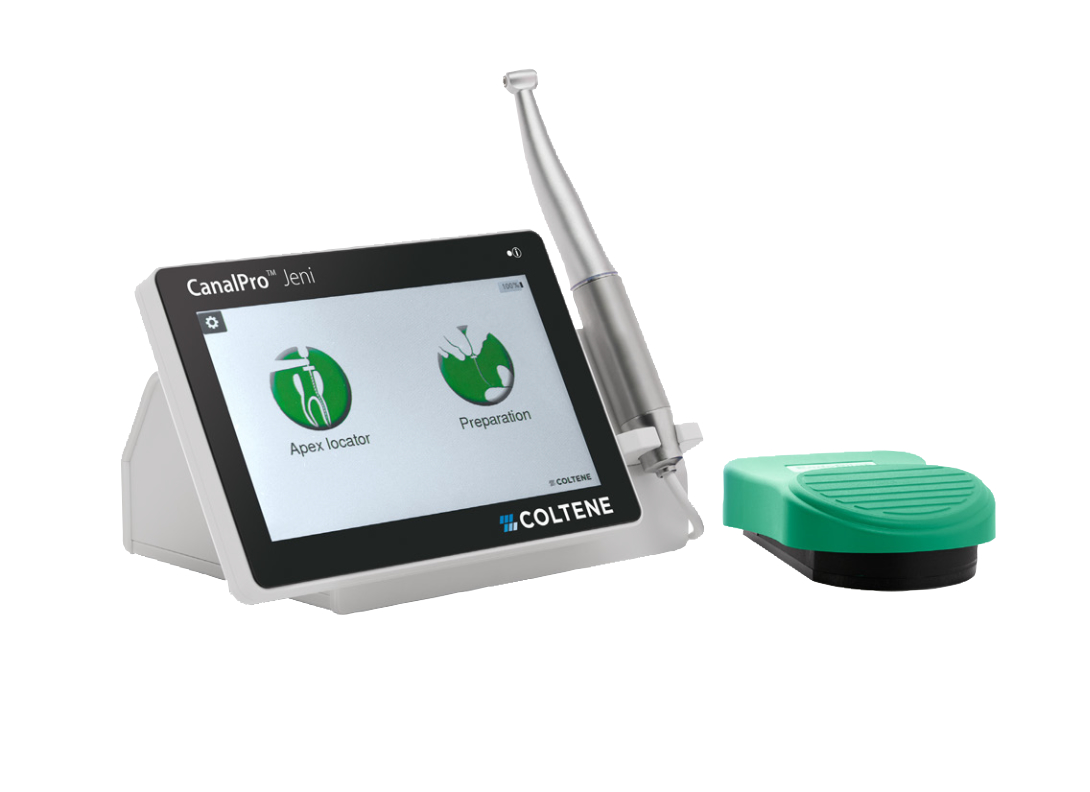
CanalPro™ Jeni, from COLTENE, is the autonomous assistance system that helps clinicians achieve safer, more efficient root canal treatment. Jeni features an integrated apex locator, continuously and precisely measuring root canal length without interruption. This enables you to monitor progress in real time, and switch to the next file size until the desired preparation has been achieved. CanalPro™ Jeni will also alert you when it’s a good time to irrigate, as well as monitor factors like intensity, torque, and file stress, helping to reduce the risk of file fracture.
Modern solutions could be the key to more accurate, and safer endodontic treatment. By implementing these solutions in your practice, you can improve root canal treatment outcomes, and enhance patient experiences, ensuring precise workflows. The use of an apex locator as a supplement in your endodontic practice will enable you to consistently monitor each patient’s anatomy and produce more ideal outcomes, thoroughly removing infection from the affected canals.
For more on COLTENE, visit www.coltene.com, or call 0800 254 5115.
COLTENE loyalty scheme https://rewards.coltene.com

Mark Allen
Author: Mark Allen, General Manager at COLTENE
[i] Khanna, Ateksha Bhardwaj. “Applications of cone beam computed tomography in endodontics.” Evidence-Based Endodontics 5.1 (2020): 1-16.
[ii] Brunton, Paul A., Dilshan Abdeen, and Tatiana V. Macfarlane. “The effect of an apex locator on exposure to radiation during endodontic therapy.” Journal of Endodontics 28.7 (2002): 524-526.
[iii] Yusof, Z. Y. M., and P. Nambiar. “Radiographic considerations in endodontics.” Malaysian Dental Journal 28.1 (2007): 51-58.
[iv] Altenburger, M. J., et al. “Combination of apex locator and endodontic motor for continuous length control during root canal treatment.” International endodontic journal 42.4 (2009): 368-374.







