


Straight or Scalloped? Why the design of your clear aligner matters.
Featured Products Promotional FeaturesPosted by: Dental Design 6th October 2023
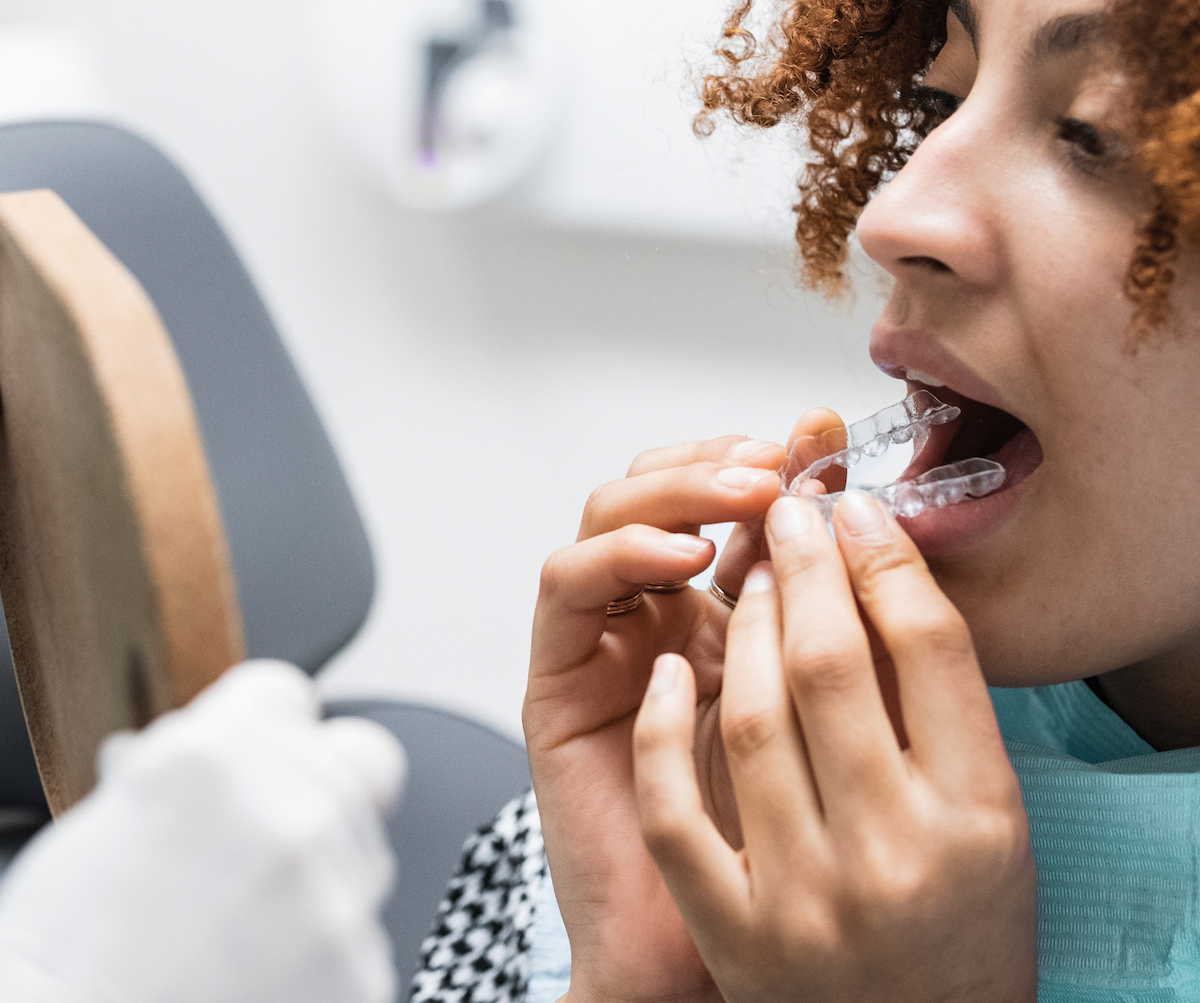
Clear aligners present a popular and aesthetic orthodontic treatment for many patients. Additionally, as technology continues to develop, clear aligner therapy is being considered suitable in more challenging cases. However, with the various options available, it is important to have a good idea of the scientific research into clear aligner design to enable you to provide your patients with the predictable treatment they need.
Tooth movement
Providing orthodontic treatment requires a good understanding of the ways in which teeth move. This movement is dependent on a number of factors including the resulting force, its application, magnitude, and direction, and the centre of resistance of the tooth,[i] which is located in the root.
Clear aligners apply force by shape moulding or by force directed application. Shape moulding relies on the intimate contact of the aligner with the anatomy of the tooth surface. Areas of pressure and relief are programmed into the aligner to apply forces over the surface of the tooth in the desired areas, depending on the movement required. Because the aligner material is in contact with the entire crown, the forces applied during treatment are spread over a wider surface area than in traditional fixed treatment. This can mean that, depending on the aligner design, tooth movement can be harder to predict.i
By adding strategically placed engagers, the dentist can apply force driven movements in desired areas to enhance predictability of the shape moulding movements. This accounts for, on average, 20% of aligner movements, with shape moulding force application 80%.[ii]
Applying even forces during aligner treatment
 To move teeth predictably, the aligner must apply forces to the appropriate area of the tooth surface. If this does not happen, there is a risk that a tilting motion will occur, with too much force on the incisal edge, and not enough at the gingival margin. Therefore, for torque control, when appropriate for the individual case, the forces at the gingival margin should be higher than the incisal edge.i
Research suggests that it can be challenging to achieve this balance using a clear aligner system, however, the design of the aligner itself can drastically improve predictability of movement.i
The effects of a high trimline
 Various clear aligner providers have different aligner designs. A scalloped edge, for example, is designed for improved aesthetics for the person undergoing treatment. This type of aligner follows the natural gingival margins, requiring polishing which may weaken the material and lead to extremely flexible edges. This can mean that, in aligners which have scalloped edges, there is a less even force distribution. The pressure exerted with shape moulding force application is far less at the gingival margin,i and more concentrated at the incisal edge, which is further away from the centre of resistance.
However, in aligners which feature extended, straight margins, polishing and weakening is reduced, and the grip on the tooth surface, along with the control of movement, is improved.i The aligner design which is considered to provide the most effective retention features a straight trimline, which is cut 2mm above the gingival margin. Straight margins also reduce the need for attachments and are able to perform more complex tooth movements – like torqueing, for example – and increase tooth movement.[iii]
ClearCorrect® aligners are precision engineered to deliver more predictable treatment results and aligners feature a high, flat trimline, which is scientifically proven to deliver greater control, and consistent application of force. All of this allows clinicians to predictably achieve more complex movements.[iv] The trimline optimises force transmission and enhances root control, and is 2.5x more retentive than scalloped aligners – this reduces the need for engagers.iii
The right choice in each case
Clear aligner technology continues to develop, providing clinicians more opportunity to offer the treatment type to their patients in increasingly complex cases. However, it is important to understand the effects that each aligner design may have on treatment outcomes. An aligner which is well-fitting, with a high, flat trimline should be expected to apply higher forces, for a longer period of time, enabling the clinician to achieve more accurate movements, predictably.i
For more information on ClearCorrect®, visit:
Author bio:

Rob Wood
Clinical Advisor
Rob Qualified from Leeds Dental School in 2007. Having lived in Australia for 8 years, he recently returned to the UK to pursue his passion for education and leadership.
He has experience in all areas of general dentistry and his emphasis has always been on ethical and patient centred care. As well as completing certificates in Implantology and Endodontics, he was a provider of Clear Aligner therapy and Cosmetic dentistry when working in Australia. Due to his love of the outdoors, Rob also explored his interest in management and innovation by developing a chewable toothpaste tablet, which is sold across Australia.
Rob has been a Clinical Advisor for ClearCorrect® since October 2022. He has gained a post graduate diploma in Clinical Education and is currently studying for a diploma in orthodontics.
[i] Tarek M. Elshazly, Ludger Keilig, Damiano Salvatori, Philippe Chavanne, Mostafa Aldesoki, Christoph Bourauel. “Effect of trimming line design and edge extension of orthodontic aligners on force transmission: An in vitro study”. Journal of Dentistry 125 (2022) 104276
[ii] Upadhyay, Madhur, and Sarah Abu Arqub. “Biomechanics of clear aligners: hidden truths & first principles.” Journal of the World Federation of Orthodontists 11.1 (2022): 12-21.
[iii] Daniel P. Cowley, James Mah, and Brendan O’Toole. “The effect of gingival-margin design on the retention of thermoformed aligners”. Journal of Clinical Orthodontics: JCO 11/2012; 46(11):697-702.6.
[iv] Elshazly, T. et al. “Effect of Trimming Line Design and Edge Extension of Orthodontic Aligners on Force Transmission: An in vitro Study.” Journal of Dentistry (2022). doi: https://doi.org/10.1016/j.jdent.2022.1042765.







