


The bigger picture
Featured Products Promotional FeaturesPosted by: Dental Design 9th January 2024
Why the sky’s the limit for dental images and cloud storage
The average patient record contains a vast amount of data–charts, referral letters, consultant reports, prescriptions and billing information are just the tip of the iceberg. And with the major advances in digital imaging, dental practitioners are also now dealing with thousands upon thousands of image files.
As you know, dental practices are directly responsible for the data held on patients, and those who are data controllers in the practice must be registered with the Information Commissioner’s Office.[i]
The GDC’s Standard 4.5 states that dental professionals must “keep patients’ information secure at all times, whether records are held on paper or electronically.”[ii]
It also says that dental professionals must “make sure that patients’ information is not revealed accidentally and that no one has unauthorised access to it by storing it securely at all times.” Indeed, all data and images gathered are subject to the Data Protection Act 1998 and therefore dental professionals must follow its guidance to ensure that data is stored safely and securely.[iii]
Hard times
Up until recently, the most common approach for storage has been the use of external hard drives. Images can be stored on a personal computer and further backed-up to an external hard drive. While the ease and relative cost-effectiveness of this approach may seem attractive, there are fundamental flaws in this approach that risk the loss of data. This is because the data is stored in a single place and therefore an event such as a fire or a robbery could risk the loss of all data.
Another factor to be aware of is the annualised failure rate (AFR) for hard drives, which has increased over the last three years. For example, Backblaze,[iv] the American cloud storage company, recorded an AFR of 0.93% in 2020 and 1.10% in 2021. The AFR for 2022 was up to 1.37%. The main reason for the increase is due to the age of the drives. Like any other hardware, hard drives are more prone to failure as they age.[v]
Given that the DDU’s data in the UK states that records need to be kept for 11 years for an adult,[vi] the advent of cloud-based storage systems presents an attractive option. It also chimes with the government’s Cloud First policy for healthcare providers.[vii]
There are several reasons why using cloud storage for images in a dental practice can be beneficial. Firstly, it’s a cost-effective option.[viii] Cloud storage eliminates the need for expensive on-site servers and equipment, saving the practice money on hardware and maintenance costs.
It also offers scalability.[ix] Cloud storage can easily adapt to the changing storage needs of a dental practice. As the number of images and files increase, the cloud storage can be easily expanded to accommodate the growing data.
Cloud collaboration
 Then there’s the benefit of accessibility.[x] With cloud storage, dental professionals can access patient images from anywhere at any time, as long as they have an internet connection. This allows for increased mobility and flexibility, enabling dentists to access and share images with specialists or colleagues for consultations or second opinions. Dentists, hygienists and specialists can securely share and work on images simultaneously, leading to improved communication and coordination within the dental team. And with digital imaging increasingly being used as a patient information tool to allow patients to be more involved in shared decision making, easy accessibility is key.
Cloud storage can offer peace of mind on the data backup and recovery front. It typically includes data backup and recovery features, which can help protect against data loss due to hardware failures, natural disasters, or other unforeseen events. This ensures that valuable patient images are safe and can be easily recovered if needed.
Similarly, trusted cloud storage providers implement robust security measures to protect stored data.vii This includes encryption, user access controls and constant monitoring, ensuring that patient images remain private and secure.
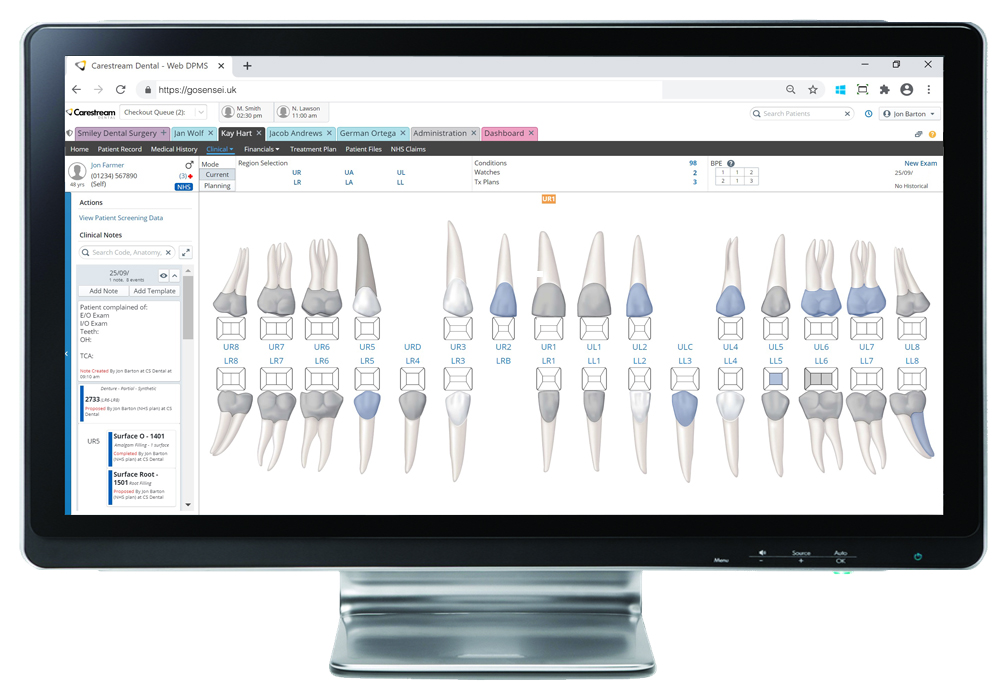
Sensei Imaging is part of Sensei Cloud, the Software-as-a-Service platform from Sensei. It is a dental imaging software solution to safely and securely store patient images, allowing dental professionals to access records at their convenience. It works with existing technology, so practices don’t have to interrupt their workflow for an upgrade. It encompasses a whole suite of diagnostic, browser-based dental imaging software tools, enabling dental professionals to grow their business and focus on what’s most important–their patients.
Overall, cloud storage offers dental professionals a convenient, cost-effective, and secure solution for storing and accessing patient images, enhancing efficiency and collaboration within the practice. And with its additional scalability benefit, dental professionals really can shoot for the sky!

For more information on Sensei Cloud visit gosensei.co.uk
For the latest news and updates, follow us on Facebook and Instagram @carestreamdental.uk

[i] Information Commissioner’s Office https://ico.org.uk/for-organisations/
[ii] General Dental Council https://standards.gdc-uk.org/pages/principle4/principle4.aspx
[iii] British Dental Association https://bda.org/gdpr
[iv] Backblaze Inc, backblaze.com
[v] Backblaze https://www.backblaze.com/blog/backblaze-drive-stats-for-q2-2022/
[vi] Dental Defence Union https://www.theddu.com/guidance-and-advice/guides/information-governance-in-dental-practices
[vii] Gov.uk https://www.gov.uk/guidance/government-cloud-first-policy
[viii] Hassan J, Shehzad D, Habib U, Aftab MU, Ahmad M, Kuleev R, Mazzara M. The Rise of Cloud Computing: Data Protection, Privacy, and Open Research Challenges-A Systematic Literature Review (SLR). Comput Intell Neurosci. 2022 Jun 7;2022:8303504. doi: 10.1155/2022/8303504. PMID: 35712069; PMCID: PMC9197654. [Accessed October 2023]
[ix] Al-Said Ahmad, A., Andras, P. Scalability analysis comparisons of cloud-based software services. J Cloud Comp 8, 10 (2019). https://doi.org/10.1186/s13677-019-0134-y [Accessed October 2023]
[x] Tahir A, Chen F, Khan HU, Ming Z, Ahmad A, Nazir S, Shafiq M. A Systematic Review on Cloud Storage Mechanisms Concerning e-Healthcare Systems. Sensors (Basel). 2020 Sep 21;20(18):5392. doi: 10.3390/s20185392. PMID: 32967094; PMCID: PMC7570508. [Accessed October 2023]







