


Empower implant patients to optimise oral hygiene
Featured Products Promotional FeaturesPosted by: Dental Design 13th January 2024
Thousands of people are now seeking out dental implant treatment every year. Patients are understanding the many benefits of associated therapies, and how a dental implant can look and function similar to a natural tooth. They are also finding out how these treatments can be delivered with minimal chair-time, and are often more affordable than many think.
For patients, one advantage of choosing a dental implant is knowing that, with correct maintenance, they can last for many years. It is crucial, therefore, that they understand how important their own role is in ensuring treatment stability and are willing to commit to all the behaviours required.
Success starts from the planning stage
Although success rates are high for implant therapies – a one-year follow-up study reported a survival rate of 95.5% – there has to be on-going vigilance for all potential complications that could compromise the outcome.[i]
The most common reason for implant complication and failure is infection. Careful monitoring and management of anything that could indicate the inflammatory and destructive condition peri-implantitis, must be conducted by the dental team. Regular appointments, to check all is well, can minimise the threat, as can smoking cessation along with making other lifestyle changes.[ii],[iii]
Poor plaque control is another factor, which is where the patient’s willingness to adopt an elevated dental cleaning routine is fundamental.
Helping patients choose
Comprehensive home care can help keep a dental implant beautifully maintained, and help patients avoid peri-implant infection. It is their responsibility to keep up the deep-clean habit, but professionals must engage them via education, so they truly understand the reasons behind their actions.
With your help, they will feel more confident that they are doing all they can to keep their implant(s) stable. An implant care routine will start with the basics of toothbrushing. Then, cleaning interdentally, which is something every patient should be doing – looking after the interproximal areas has enormous benefits for all-round oral and general health. And, with the right tools, it is perfectly safe for implant patients to do. Cleaning between will disrupt the deposits of calculus that, if left untouched, can lead to an increased risk of peri-implant disease.[iv]
For some patients, they will need to adopt new or update their current at-home routines. The field of behavioural science is an entity to itself, but for dental professionals, having a basic understanding of what drives patient habits can be useful in helping them to make changes. This means ensuring that a patient has the capability (physical or psychological ability), opportunity (with regards to their home environment or access to products) and motivation (desire) to implement positive adjustments to their oral hygiene routine.[v] The dental team should be educating patients and providing reliable information on the benefit of any recommended changes to their habits in order to help understand the importance of following advice. This should be backed up with continuous encouragement and practical support where appropriate, for example, when it comes to practising techniques or selecting products.
Making the job a pleasure
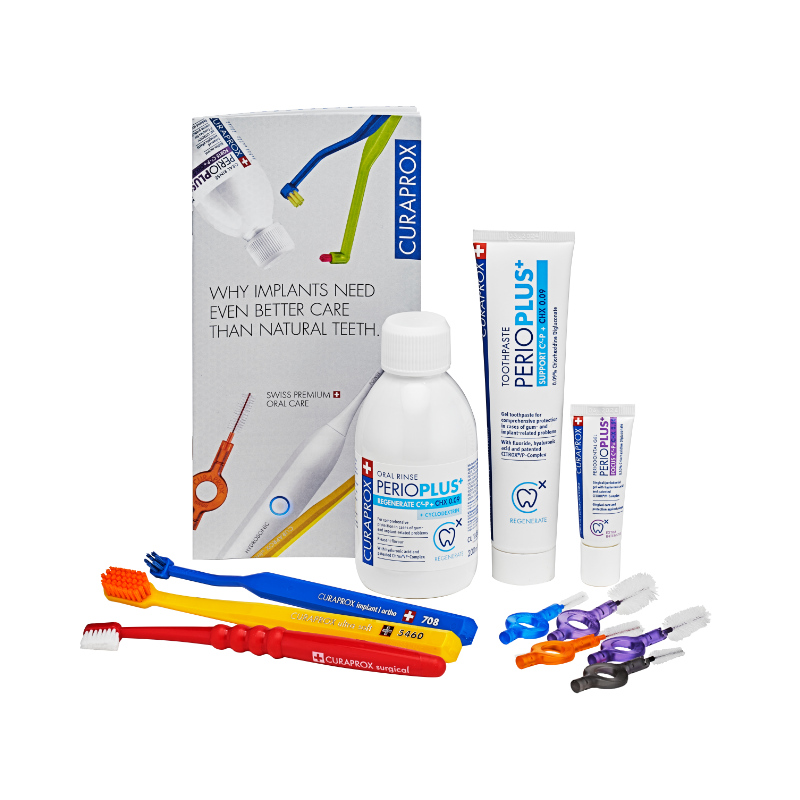
To make the job of deep, comfortable everyday cleaning easy for implant patients, premium Swiss oral care brand, Curaprox, has produced an Implant Care Kit, with everything needed in one handy pack. Excellent as a teaching aid too, it contains a toothbrush, interdental tools also toothpaste and mouth rinse, so they know exactly what to reach for, every day.
All Curaprox toothbrushes are designed to remove plaque gently, without scrubbing. That is thanks to the ultra-fine Curen® filaments, which are densely packed yet can move around the teeth easily and efficiently. Once they have brushed, patients can clean between with a CPS Prime interdental brush for implants, which only need a single movement, once a day, to get between the hard-to-reach spaces. Also included is a Perio Plus+ Regenerate mouthwash, containing Citrox®, a natural bioflavonoid extracted from bitter oranges. Adhering well to the teeth, gums and oral mucosa, this completes the Kit.
It is good to remind implant patients that, for the most past, their implant-retained crown is just like a ‘normal’ tooth – and so it requires the same level of TLC. This means attention to scrupulous daily cleaning and oral hygiene practises. But to keep their treatment results beautifully maintained for as long as possible, they should elevate their routine using high-quality products that are proven to work. With your help, they can enjoy their new smile for many years to come.

For more information, please visit www.curaprox.co.uk

[i] den Hartog L, Slater JJ, Vissink A, Meijer HJ, Raghoebar GM. (2008). Treatment outcome of immediate, early and conventional single-tooth implants in the aesthetic zone: a systematic review to survival, bone level, soft-tissue, aesthetics and patient satisfaction. J Clin Periodontol 35:1073-1086
[ii] Abduljabbar T, Al-Sahaly F, Kellesarian SV, Kellesarian TV, Al-Anazi M, Al-Khathami M, Javed F, Vohra F.
Comparison of peri-implant clinical and radiographic inflammatory parameters and whole salivary destructive inflammatory cytokine profile among obese and non-obese men. Cytokine. 2016; 88: 51-56. ISSN 1043-4666. https://doi.org/10.1016/j.cyto.2016.08.017.
[iii] Astolfi V, Ríos-Carrasco B, Gil-Mur FJ, Ríos-Santos JV, Bullón B, Herrero-Climent M, Bullón P. Incidence of Peri-Implantitis and Relationship with Different Conditions: A Retrospective Study. Int J Environ Res Public Health. 2022 Mar 31;19(7):4147. doi: 10.3390/ijerph19074147. PMID: 35409826; PMCID: PMC8998347.
[iv] Cheung, M.C., Hopcraft, M.S., Darby, I.B. (2021) Patient-reported oral hygiene and implant outcomes in general dental practice. Australian Dental Journal 66: 49–60. https://doi.org/10.1111/adj.12806
[v] Department of Health. Guidance. Chapter 3: Behaviour change. November 2021. https://www.gov.uk/government/publications/delivering-better-oral-health-an-evidence-based-toolkit-for-prevention/chapter-3-behaviour-change [Accessed September 2023]







