


A crowning achievement
Featured Products Promotional FeaturesPosted by: Dental Design 22nd January 2024
What are the factors that affect dental crown longevity?
Dental crowns are commonly performed procedures. Indeed, in the most recent government survey, 47% of the population in England reported having crowned teeth.[i] They are pretty successful too, boasting a 10-year and 25-year survival rate of 97% and 85% respectively.[ii] However, they are not without their challenges, for both the dental professional and the patient.
One of the primary challenges of dental crown procedures is achieving proper tooth preparation. As you know, the tooth must be shaped and trimmed to ensure a secure fit for the crown. However, excessive removal of tooth structure can weaken it and compromise its long-term stability.[iii] On the other hand, inadequate preparation may result in an ill-fitting crown that is prone to fractures or other complications.[iv]
To address this challenge, dental professionals exercise precision and careful judgment during tooth preparation. Advanced imaging technologies can be used, such as digital scanners or X-rays, to accurately assess the tooth’s condition and determine the appropriate amount of preparation required. Additionally, these days computer aided design and manufacturing (CAD/CAM) technology play their part to create precise digital impressions and fabricate custom crowns that fit accurately.
In good shape
Another complication in dental crown procedures is achieving proper aesthetics. Patients often desire crowns that closely match the colour, shape and texture of their natural teeth. However, achieving a seamless and natural appearance can be challenging, especially when dealing with front teeth that are highly visible.[v]
To address this problem, dentists need to consult with patients to understand their aesthetic goals and preferences.[vi] Shade guides can be used to select a crown colour that matches the patient’s natural teeth or the colour customised to create a more harmonious smile. Dental technicians with expertise in cosmetic dentistry may also use advanced techniques, such as layering ceramic materials, to create crowns that mimic the translucency and natural variations of regular teeth. Advances in bonding techniques have increased the range and scope for use of ceramics in dentistry.[vii]
The choice of materials is another consideration in dental crown procedures. As you are aware, there are several options available including porcelain, ceramic, metal alloys and composite resin. Each material has its advantages and disadvantages, and choosing the right one depends on factors such as cost, aesthetics, strength and the patient’s individual needs.[viii]
To tackle this complication, dentists must consider various factors when selecting crown materials. They must evaluate the patient’s aesthetic goals, the functional requirements of the tooth, and the patient’s oral hygiene habits. By carefully weighing these factors and discussing them with the patient, dental professionals can make informed decisions regarding the choice of materials that will best suit their needs.[ix]
Optimum occlusion
 Ensuring a proper fit and occlusion is of key importance too. A crown that does not fit properly can cause discomfort, sensitivity, or even lead to secondary dental problems.[x] Moreover, a misaligned crown can cause malocclusion, causing chewing difficulties and potential long-term issues with the jaw joints.[xi]
To overcome fit issues, dental professionals can utilise modern techniques such as intraoral scanners to obtain precise digital impressions of the dentition and gingiva. These digital impressions can be used to create virtual models of the patient’s mouth, allowing dentists to assess the fit and occlusion of the crown before it is fabricated.
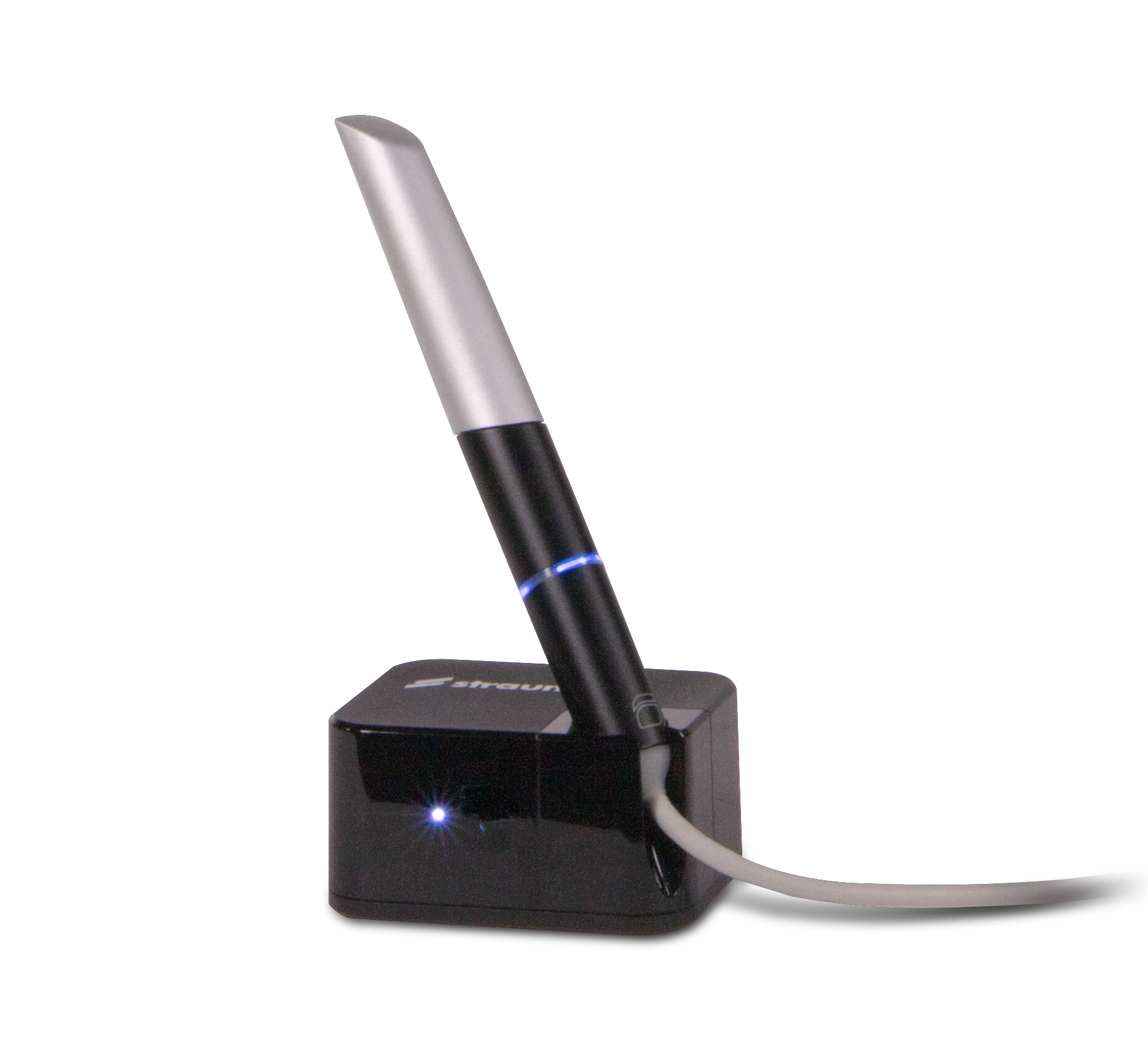
The Virtuo VivoTM Intraoral Scanner from Straumann® offers a great introduction into the world of digital dentistry. It is a light (only 130g) and small handpiece, ergonomically designed to provide a pen-like grip and exceptional patient comfort. Teeth and soft tissue can be scanned from multiple orientations, capturing difficult-to-see areas with minimal effort. Resulting scans are in colour and high resolution. The scanner boasts a removable, autoclavable sleeve in coated metal to ensure proper hygiene for the patient and practice. It is also incredibly fast with the ability of doing a lower scan in the mouth in around 20 seconds.
Dental crown procedures can present several challenges, ranging from achieving proper tooth preparation to ensuring optimal aesthetics, fit and occlusion. However, with advancements in dental technology and the expertise of dentists, these challenges can be effectively addressed. By employing precision techniques and utilising modern tools, dentists can provide patients with their crowning glory – successful and aesthetically pleasing dental crown procedures.

For more details, please visit
https://www.straumann.com/digital/us/en/home/equipment/io-scanners.html
[i] Public Health England, Oral health survey of adults attending dental practices 2018 https://www.gov.uk/government/publications/oral-health-survey-of-adults-attending-dental-practices-2018
[ii] Walton TR. The up to 25-year survival and clinical performance of 2,340 high gold-based metal-ceramic single crowns. Int J Prosthodont. 2013 Mar-Apr;26(2):151-60. doi: 10.11607/ijp.3136. PMID: 23476910. [Accessed October 2023]
[iii] Sharma A, Rahul GR, Poduval ST, Shetty K. Short clinical crowns (SCC) – treatment considerations and techniques. J Clin Exp Dent. 2012 Oct 1;4(4):e230-6. doi: 10.4317/jced.50556. PMID: 24558561; PMCID: PMC3917630. [Accessed October 2023]
[iv] Rajnekar R, Mankar N, Nikhade P, Chandak M, Burde K. Conservative Management of Complicated Crown-Root Fracture: An Immediate Esthetic Rehabilitation. Cureus. 2022 Jun 3;14(6):e25627. doi: 10.7759/cureus.25627. PMID: 35785013; PMCID: PMC9249066. [Accessed October 2023]
[v] Verma RK, Srilatha V, Patel S, Dithi C, Somaraj V, Vallabhaneni SK. Assessment of Parental Satisfaction with Various Aesthetic Crowns Among Children of Various Age Groups: An Original Research. J Pharm Bioallied Sci. 2023 Jul;15(Suppl 1):S196-S200. doi: 10.4103/jpbs.jpbs_452_22. Epub 2023 Jul 5. PMID: 37654360; PMCID: PMC10466644. [Accessed October 2023]
[vi] J.T. Newton, S.S. Subramanian, S. Westland, A.K. Gupta, W. Luo, A. Joiner, The impact of tooth colour on the perceptions of age and social judgements., Journal of Dentistry, Volume 112, 2021, 103771, ISSN 0300-5712, https://doi.org/10.1016/j.jdent.2021.103771[Accessed October 2023]
[vii] Shenoy A, Shenoy N. Dental ceramics: An update. J Conserv Dent. 2010 Oct;13(4):195-203. doi: 10.4103/0972-0707.73379. PMID: 21217946; PMCID: PMC3010023. [Accessed October 2023]
[viii] Makhija SK, Lawson NC, Gilbert GH, Litaker MS, McClelland JA, Louis DR, Gordan VV, Pihlstrom DJ, Meyerowitz C, Mungia R, McCracken MS; National Dental PBRN Collaborative Group. Dentist material selection for single-unit crowns: Findings from the National Dental Practice-Based Research Network. J Dent. 2016 Dec;55:40-47. doi: 10.1016/j.jdent.2016.09.010. Epub 2016 Sep 28. PMID: 27693778; PMCID: PMC5125852. [Accessed October 2023]
[ix] Yuan S, Freeman R, Hill K, Newton T, Humphris G. Communication, Trust and Dental Anxiety: A Person-Centred Approach for Dental Attendance Behaviours. Dent J (Basel). 2020 Oct 13;8(4):118. doi: 10.3390/dj8040118. PMID: 33066178; PMCID: PMC7712465.[Accessed October 2023]
[x] Amlani DV, Brizuela M. Stainless Steel Crowns in Primary Dentition. [Updated 2023 Mar 19]. In: StatPearls [Internet]. Treasure Island (FL): StatPearls Publishing; 2023 Jan-. Available from: https://www.ncbi.nlm.nih.gov/books/NBK574547/ [Accessed October 2023]
[xi] InformedHealth.org [Internet]. Cologne, Germany: Institute for Quality and Efficiency in Health Care (IQWiG); 2006-. Misaligned teeth and jaws: Overview. 2020 Jan 16. Available from: https://www.ncbi.nlm.nih.gov/books/NBK553375/ [Accessed October 2023]







