


Logical logistics
Featured Products Promotional FeaturesPosted by: Dental Design 2nd November 2021
The last year has been a rough one for logistics. A host of local and international factors have come together in an almost perfect storm that has squeezed supply chains across just about every industry. We live in a very interconnected world, which has brought tremendous benefits – but that complicated web can still get its strands tied or cut.
The pandemic has created a challenging environment for suppliers and hauliers, with personnel shortages and restrictions affecting production and shipping. Against this background pressure, additional factors have caused considerably more chaos and disruption than they would have in less strained times. In recent months we have seen the Suez Canal blocked by a container ship mishap, extreme weather disruption (which is predicted to play an increasing role as the climate continues to change), and a myriad of more localised issues. Certain electronics and computer parts are in short supply, fed by both raw material and production shortages, coupled with an explosion in demand caused by a sudden shift to homeworking and the on-going cryptocurrency goldrush. Political factors such as Brexit have also contributed to disruption, causing delays and complications to imports and exports.
As pandemic restrictions lift, many producers are having to rapidly recalibrate in response to demand. A lot of dental work was necessarily delayed or deferred during lockdown, creating a glut of work that practices are still shifting through, and with it demand for certain tools and supplies. The resumption in work brings with it a surge in orders for specialised equipment and materials, which in some places may leave suppliers flatfooted. Many products required by the profession are made to exacting standards and require components made from now highly in demand materials. For example, dental bur designs can require diamonds and comparatively rare alloys, the price of which can be driven up by overlapping demand for raw materials.[i]
Dental practices are the endpoint for a wide variety of specialist supplies, tools and equipment, leaving them exposed to procurement disruption on numerous fronts. This can cause delays to treatment and stress, as well as increased costs. So, what can practices do to mitigate and insulate against these risks?
One strategy is to stock up on things you think you will need in the near future, which can potentially keep a supply chain delay from leaving you shorthanded. This approach is suboptimal for numerous reasons. Firstly, many practices have quite limited storage space to begin with, and attempting to overfill what space there is can create obvious problems. Secondly, precisely predicting what you will require in the future is difficult and time consuming, as widely evidenced in attempts at planned economies. Getting it wrong can result in unnecessarily high costs due to over-purchasing, or again being left shorthanded at a critical time if demand is unexpectedly high. We have also recently seen how disastrous this approach is when many people attempt to stock up at the same time, it leads to unnecessary shortages. The shortages of toilet paper due to panic buying are a vivid example of this that few are likely to forget any time soon.

A much more workable strategy is to, wherever possible, simplify your procurement. The more systems from different suppliers you are running, the more complicated supply and maintenance becomes. Each practice’s needs are different, so there are no hard and fast rules for how to go about this, but there are often considerable efficiency savings to be made by re-evaluating your set up.
There are also efficiency savings to be made from taking advantage of offsite capabilities. Cloud computing is a fantastic example of this. Cloud computing reduces the need for end users to keep up to date with the latest hardware, and the maintenance headaches of updates, backups, and repair. All of this is handled on the backend by the provider, enabling the user to simply use the application they need with none of the traditional hassle.
Further complicating matters is the fact that many treatments require bespoke appliances to be created for patients, the huge degree of anatomical variation between patients means we cannot simply use off the shelf standardised restorations. Traditionally, measurements and impressions were taken in the practice, then sent off to a laboratory to have pieces created. Some practices have been able to bring production of appliances in-house, though the barriers to entry are steep and impractical for some practices. In-house solutions can also add to the maintenance burden of a practice.
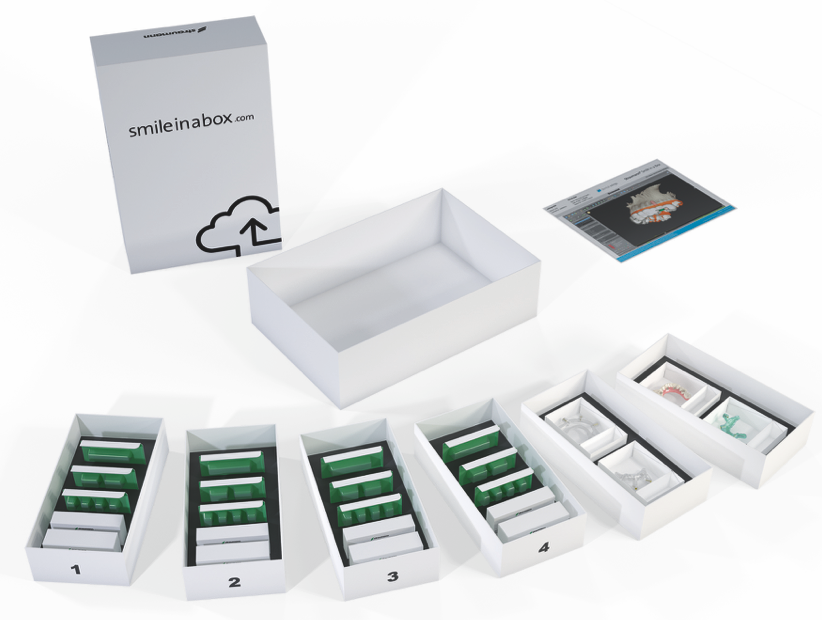
The Straumann® Smile in a Box solution empowers practitioners to take advantage of the latest advances in digital treatment planning and manufacturing, simply and efficiently without hassle. You merely select the treatment planning and/or manufacturing services you require for your specific surgical or prosthetic indication, and Straumann® will deliver everything you need in a single box for ultimate convenience and flexibility.
Reliable outsourcing partners can be the ideal solution. You get the advantage of logistics of scale and bulk ordering power, of heavy investment into the latest technologies, but without the overhead and risks – it can be a real win-win situation.
For more information on the Straumann® Smile in a Box, visit https://www.straumann.com/digital/en/discover/smile-in-a-box.html
[i] Allied Market Research. Global dental burs and endodontic market to generate $2.12 billion by 2028: allied markt research. Yahoo! Finance. 2021. https://finance.yahoo.com/news/global-dental-burs-endodontic-market-140300875.html July 8, 2021.







