


Iconic longevity
Featured Products Promotional FeaturesPosted by: Dental Design 21st April 2022
The world’s oldest person, Kane Tanaka, has celebrated her 119th birthday.[i] This wonderful feat of human longevity demonstrates a larger phenomenon – that the world’s population is living longer and are still enjoying a fulfilling life in their later years. Thus, care for older patients must continue to be adapted and enhanced to ensure that they are receiving care that best suits their needs, and allows them to live their life to the fullest.
Approximately 19% of the UK population is aged 65 or over.[ii] As a dentist, you will have encountered many patients who fall within this bracket and so understand that they may require a tailored approach to care. This is particularly important should they desire dental implants.
As the older population are more prone to oral health complications,[iii] undergoing implant treatment could present some challenges. However, all patients should feel confident and comfortable with their smiles, so it’s vital that every step is taken to ensure they can have safe treatment, enjoy long-lasting implants and enjoy a better quality of life.
What could go wrong?
Certain health conditions may put older patients at risk of failed implants. Xerostomia has been shown to be common amongst the elderly population,[iv] and can be caused by certain medications and conditions, such as Sjögren’s syndrome. As a chronic dry mouth increases the risk of bacteria accumulation,[v] dental implants could be at a higher risk of failure. However, research[vi] [vii] has shown that implant treatment could be feasible for patients with Sjögren’s syndrome, as high survival rates were noted as well as an increase in the quality of life of the participating patients.
It is estimated that almost three million people in the UK have osteoporosis,[viii] with a noted prevalence in the elderly population.[ix] Osteoporosis can have a drastic impact upon an individual’s life; as well as pain, everyday habits such as walking and dressing may become considerably demanding.[x] Due to the nature of the condition, osteoporosis has been considered as a potential contraindication to implant treatment, as osseointegration could be affected.[xi] Encouragingly, much research has demonstrated the potential for successful implant treatment in patients with this condition. One study[xii] examined the long-term success and marginal bone loss (MBL) of dental implants in postmenopausal women with osteoporosis; the researchers concluded that the condition did not affect the participants’ MBL or the long-term success of the implants. Similarly, other literature[xiii] [xiv] has stated that osteoporosis was not a contraindication for implant treatment, with one study[xv] finding that the implant survival rate was no different between patients with and without osteoporosis.

A general reduction in manual dexterity not only affects the elderly populations’ oral health, but may also explain the likelihood of implant failure. A study[xvi] investigated whether a reduced manual dexterity was a predictor of poor oral hygiene in the elderly population; it was found that participants with low manual dexterity had more dental biofilm than those with normal dexterity. These findings could highlight an issue faced by elderly individuals in the maintenance of their oral health. In a study[xvii] aiming to evaluate the outcome of implant treatment in elderly patients, peri-implant mucositis was noted as a common biological complication. Whilst not necessarily the result of poor dexterity, this evidence suggests that poor oral hygiene in elderly patients is still a factor in the failure of their implant treatment. Thus, continuing to advise older patients on how they can best care for their oral health is paramount, especially to ensure the success of their implants.
Innovations in implantology
Due to the ever-evolving innovations in dentistry, issues faced by older patients are no longer such stringent barriers to certain dental treatments. Dental implants have become a feasible option for many, whether the purpose is for improved comfort or to boost self-esteem.
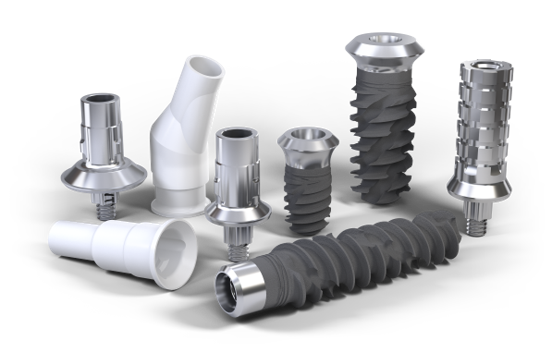
With many individuals living longer lives, it is crucial that they also enjoy good oral health with a smile they can wear proudly. Despite certain factors that could affect the treatment, it is generally accepted that dental implants can be placed with careful planning and risk assessment. Furthermore, the systems used during treatment can enhance both the placing of the implant and its chance for success. The new TLX® implant system, proudly delivered by the powerhouse Straumann®, is one such system. Designed with the perseveration of peri-implant health in mind, the TLX® implant system reduces the risk of nesting bacteria, optimising cleansability with the soft-tissue level connection. With reduced invasiveness and a simple, efficient design, the TLX® implant system help you to deliver exceptional, reliable outcomes.
By employing solutions and systems that provide unparalleled standards of excellence, your patients can enjoy aesthetic and satisfying results, for all the years to come.

For more details, please visit http://www.straumann-uk.co/tlx
[i] The Japan Times. (2022). World’s oldest person celebrates 119th birthday. [online] Available at: https://www.japantimes.co.jp/news/2022/01/02/national/japanese-worlds-oldest-person/. Accessed 6 Jan. 2022.
[ii] Lewis, A., Barton, C. and Cromarty, H. (2021). Housing an ageing population: a reading list. commonslibrary.parliament.uk. [online] Available at: https://commonslibrary.parliament.uk/research-briefings/cbp-9239/. Accessed 6 Jan. 2022.
[iii] Ramsay, S.E., Papachristou, E., Watt, R.G., Tsakos, G., Lennon, L.T., Papacosta, A.O., Moynihan, P., Sayer, A.A., Whincup, P.H. and Wannamethee, S.G. (2017). Influence of Poor Oral Health on Physical Frailty: A Population-Based Cohort Study of Older British Men. Journal of the American Geriatrics Society, [online]. Available at: https://agsjournals.onlinelibrary.wiley.com/doi/full/10.1111/jgs.15175. Accessed 6 Jan. 2022.
[iv] Al-Hashimi, I. (2005). Xerostomia Secondary to Sjögren’s Syndrome in the Elderly. Drugs & Aging, [online] 22(11). Available at: https://pubmed.ncbi.nlm.nih.gov/16323968/. Accessed 6 Jan. 2022.
[v] www.nidcr.nih.gov. (n.d.). Dry Mouth | National Institute of Dental and Craniofacial Research. [online] Available at: https://www.nidcr.nih.gov/health-info/dry-mouth. Accessed 6 Jan. 2022.
[vi] Chrcanovic, B.R., Kisch, J. and Wennerberg, A. (2019). Dental implants in patients with Sjögren’s syndrome: a case series and a systematic review. International Journal of Oral and Maxillofacial Surgery, [online]. Available at: https://pubmed.ncbi.nlm.nih.gov/30827571/. Accessed 6 Jan. 2022.
[vii] Almeida, D., Vianna, K., Arriaga, P. and Moraschini, V. (2017). Dental implants in Sjögren’s syndrome patients: A systematic review. PLOS ONE, [online] Available at: https://pubmed.ncbi.nlm.nih.gov/29240793/. Accessed 6 Jan. 2022.
[viii] Ageuk.org.uk. (2018). Osteoporosis | Information and advice | Age UK. [online] Available at: https://www.ageuk.org.uk/information-advice/health-wellbeing/conditions-illnesses/osteoporosis/. Accessed 7 Jan. 2022.
[ix] Cannarella, R., Barbagallo, F., Condorelli, R.A., Aversa, A., La Vignera, S. and Calogero, A.E. (2019). Osteoporosis from an Endocrine Perspective: The Role of Hormonal Changes in the Elderly. Journal of Clinical Medicine, [online] Available at: https://www.mdpi.com/2077-0383/8/10/1564. Accessed 7 Jan. 2022.
[x] General (US), O. of the S. (2004). The Burden of Bone Disease. [online] www.ncbi.nlm.nih.gov. Office of the Surgeon General (US). Available at: https://www.ncbi.nlm.nih.gov/books/NBK45502/#:~:text=Many%20individuals%20who%20suffer%20fractures%20as%20a%20result%20of%20osteoporosis. Accessed 7 Jan. 2022.
[xi] Mellado-Valero, A., Ferrer-Garcia, J., Calvo-Catala, J. and Labaig-Rueda, C. (2009). Implant treatment in patients with osteoporosis. Medicina Oral Patología Oral y Cirugia Bucal, [online] Available at: https://pubmed.ncbi.nlm.nih.gov/19767691/. Accessed 7 Jan. 2022.
[xii] Toy, V.E. and Uslu, M.O. (2020). Evaluation of long-term dental implant success and marginal bone loss in postmenopausal women. Nigerian Journal of Clinical Practice, [online] Available at: https://pubmed.ncbi.nlm.nih.gov/32031087/. Accessed 7 Jan. 2022.
[xiii] J, V.C., Bhuminathan, S., Chandran, C.R. and Poovannan, S. (2017). Dental Implants in Patients with Osteoporosis – A Review. Biomedical and Pharmacology Journal, [online] Available at: https://biomedpharmajournal.org/vol10no3/dental-implants-in-patients-with-osteoporosis-a-review/. Accessed 7 Jan. 2022.
[xiv] Shibli, J.A., Aguiar, K.C.D.S., Melo, L., d’Avila, S., Zenóbio, E.G., Faveri, M., Iezzi, G. and Piattelli, A. (2008). Histological comparison between implants retrieved from patients with and without osteoporosis. International Journal of Oral and Maxillofacial Surgery, [online] Available at: https://www.sciencedirect.com/science/article/abs/pii/S0901502707010661. Accessed 7 Jan. 2022.
[xv] de Medeiros, F.C.F.L., Kudo, G.A.H., Leme, B.G., Saraiva, P.P., Verri, F.R., Honório, H.M., Pellizzer, E.P. and Santiago Junior, J.F. (2018). Dental implants in patients with osteoporosis: a systematic review with meta-analysis. International Journal of Oral and Maxillofacial Surgery, [online] Available at: https://www.sciencedirect.com/science/article/abs/pii/S0901502717314844. Accessed 7 Jan. 2022.
[xvi] Shin, N.-R. and Choi, J.-S. (2019). Manual dexterity and dental biofilm accumulation in independent older adults without hand disabilities: A cross-sectional study. Photodiagnosis and Photodynamic Therapy, [online] Available at: https://www.sciencedirect.com/science/article/abs/pii/S1572100018302564. Accessed 7 Jan. 2022.
[xvii] Srinivasan, M., Meyer, S., Mombelli, A. and Müller, F. (2016). Dental implants in the elderly population: a systematic review and meta-analysis. Clinical Oral Implants Research, [online] Available at: https://onlinelibrary.wiley.com/doi/abs/10.1111/clr.12898. Accessed 7 Jan. 2022.








