


At home in the biome
Featured Products Promotional FeaturesPosted by: Dental Design 18th January 2024
The importance of supporting healthy flora in the mouth
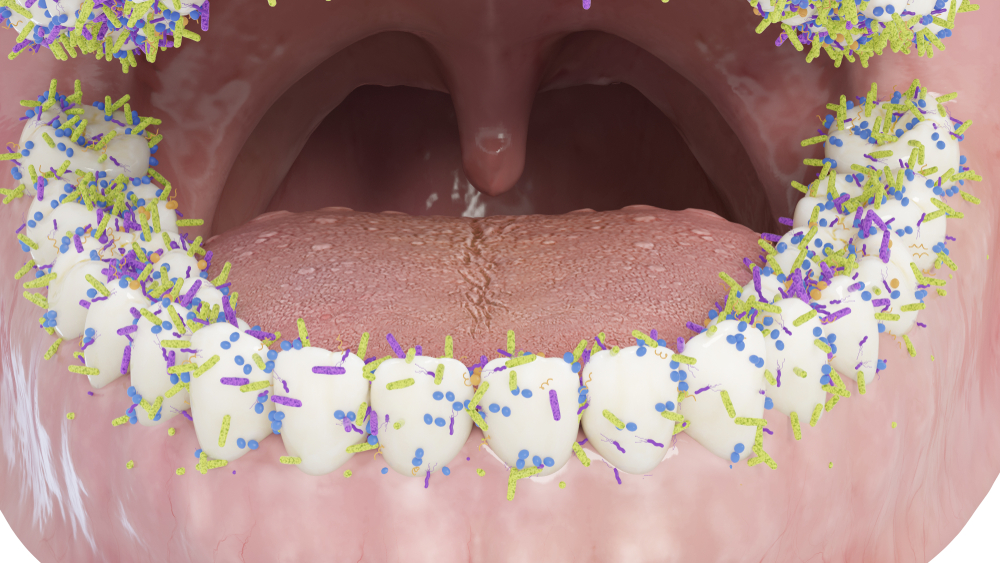
The human mouth is home to trillions of microorganisms, consisting of bacteria, viruses, fungi, and even archaea. These microorganisms form a complex ecosystem known as the oral biome.[i] While some of these microorganisms are beneficial and contribute to oral health, as you know, others can be harmful and lead to tooth decay, gum disease, and other oral infections.
The mouth has a variety of micro-environments that host different bacterial populations too; the tongue, the hard palate, the teeth, the area around the tooth surfaces, above the gums, and below the gums. Dentures also provide a protected habitat, especially beneath the fitting surface, which results in colonisation and growth by a range of bacteria and yeasts.[ii]
A balanced oral biome is vital for maintaining oral health and preventing disease. Imbalances in a patient’s oral flora can lead to gum inflammation and infection, leading to gum disease. Beneficial bacteria such as Streptococcus salivarius and Lactobacillus help to maintain oral health by producing antimicrobial substances, competing with harmful bacteria for resources, and regulating the immune response in the mouth.i
Saliva plays a major role in determining whether the resident oral microflora has a beneficial or a destructive relationship with the host. The buffering action of saliva ensures that the pH of the mouth is maintained around neutrality, which favours the growth of the majority of bacteria associated with good oral health.ii
Dental biofilm is the first sign of forecasted dental problems. Biofilms present in the oral cavity are essential for the sustenance of good oral health but an increase in the volume and complexities of these biofilms can result in diseases like gingivitis and periodontitis.[iii]
Microorganisms present in the oral cavity form a layer on the oral surfaces. Once a single layer is formed, these microorganisms start piling up and form multiple layers which result in the formation of a multicellular matrix. Microscopic evaluation of these biofilms indicates that Streptococcus accounts for around 80 per cent of this colonisation.[iv]
Bacteria present in oral biofilms can be good or bad depending upon its role in the oral cavity. In the condition of tooth decay, there is enamel loss which is promoted by microbial shift in the biofilms from good to bad.[v]
As you are aware, plaque is a sticky biofilm that forms on the teeth and contains a diverse population of microorganisms. When left unaddressed, plaque can harden and turn into calculus, which is more challenging to remove. By removing plaque, harmful bacteria are eliminated, reducing the risk of tooth decay and gum disease. Interproximal cleaning, particularly with interdental brushes, effectively removes plaque from the areas that are difficult to reach with regular brushing.
The dynamic relationship between the oral microflora and the host means that there is a life-long need to maintain effective oral hygiene practices to avoid future episodes of caries and periodontal disease.i
Indeed, to maintain a healthy oral biome flora, it’s important to follow good oral hygiene practices such as brushing teeth twice a day, daily interdental cleaning, and regularly visiting a dentist. Avoiding excessive use of antibacterial mouthwashes and maintaining a balanced diet that includes probiotic-rich foods can also help support a healthy oral flora.[vi]
For patients with dental restorations, such as crowns, bridges, or implants, interproximal cleaning becomes even more crucial. Plaque and bacteria build-up around the margins of dental work and prosthodontics can lead to the development of cavities and infections, compromising the longevity and functionality of the restorations.[vii] By practising effective interproximal cleaning, patients with dental work can maintain their oral flora and oral health as well as preserve their investment.
To help patients remove plaque effectively, consider recommending the FLEXI range of interdental brushes from TANDEX. Available in 11 different sizes, there is a correct solution for each patient, for a comfortable and effective clean. Each product’s handle is flexible, and the brush can be bent into the perfect shape to clean in between the back teeth. Additionally, FLEXIMax features an ergonomic handle for an even easier clean. Plus, FLEXI brushes can be used to easily apply PREVENT GEL, which contains 0.12% chlorhexidine and 900ppm fluoride for antibacterial and enamel strengthening properties.
The oral biome is a complex ecosystem that influences oral health significantly. Proper maintenance of the oral biome requires regular interproximal cleaning to remove plaque and bacteria from the spaces between teeth. Interproximal cleaning plays a vital role in preventing tooth decay, gum disease, bad breath, and preserving dental work.

For more information on Tandex’s range of products,
visit https://tandex.dk/ or visit the Facebook page: https://www.facebook.com/TandexUK
Our products are also available from CTS Dental Supplies https://www.cts-dental.com/ and DHB Oral Healthcare https://dhb.co.uk/
Author Kimberley Lloyd- Rees on behalf of Tandex

Kimberley graduated from the University of Sheffield in 2010, where she now works as a clinical tutor in Dental Hygiene and Therapy as well as working in practice. She has spent her career working across a variety of specialist private and mixed dental practices, for the MOD and volunteering her time to a dental charity in Nepal.
[i] Deo PN, Deshmukh R. Oral microbiome: Unveiling the fundamentals. J Oral Maxillofac Pathol. 2019 Jan-Apr;23(1):122-128. doi: 10.4103/jomfp.JOMFP_304_18. PMID: 31110428; PMCID: PMC6503789. [Accessed October 2023]
[ii] Marsh PD, Percival RS. The oral microflora–friend or foe? Can we decide? Int Dent J. 2006 Aug;56(4 Suppl 1):233-9. doi: 10.1111/j.1875-595x.2006.tb00107.x. PMID: 16972398. {Accessed October 2023]
[iii] Saini R, Saini S, Sharma S. Biofilm: A dental microbial infection. J Nat Sci Biol Med. 2011 Jan;2(1):71-5. doi: 10.4103/0976-9668.82317. PMID: 22470238; PMCID: PMC3312703. [Accessed October 2023]
[iv] Zhu B, Macleod LC, Kitten T, Xu P. Streptococcus sanguinis biofilm formation & interaction with oral pathogens. Future Microbiol. 2018 Jun 1;13(8):915-932. doi: 10.2217/fmb-2018-0043. Epub 2018 Jun 8. PMID: 29882414; PMCID: PMC6060398. [Accessed October 2023]
[v] Sharma N, Bhatia S, Sodhi AS, Batra N. Oral microbiome and health. AIMS Microbiol. 2018 Jan 12;4(1):42-66. doi: 10.3934/microbiol.2018.1.42. PMID: 31294203; PMCID: PMC6605021. [Accessed October 2023]
[vi] Alhathloul, S. and Ali, A. (2020) Effect of Using Mouthwash Solution on Commensal Flora of the Oral Cavity among Female Students in Qassim University. Journal of Biosciences and Medicines, 8, 135-142. doi: 10.4236/jbm.2020.83012.[Accessed October 2023]
[vii] Zhang N, Melo MAS, Weir MD, Reynolds MA, Bai Y, Xu HHK. Do Dental Resin Composites Accumulate More Oral Biofilms and Plaque than Amalgam and Glass Ionomer Materials? Materials (Basel). 2016 Nov 1;9(11):888. doi: 10.3390/ma9110888. PMID: 28774007; PMCID: PMC5457238. [Accessed October 2023]







