



Go with the flow
Featured Products Promotional FeaturesPosted by: Dental Design 18th March 2024
Composites have become essential in restorative dentistry, and it’s hard to imagine a world without them. Amalgam is being phased out of UK dentistry as the field pivots to a philosophy of prevention and minimal intervention,[i] and as a result synthetic solutions are quickly ascending to fill the gap.
An excellent choice when restoring cosmetic issues, composite treatments may be more commonly requested now that the demand for aesthetic dentistry is rapidly growing, with social media acting as nothing less than rocket fuel.[ii]
As clinicians assess the options available to them to create brilliant restorations, it’s inevitable that they’ll come across flowable composites. These solutions can provide extreme advantages for dental complications, but also present complications through the potential creation of ‘voids’ or ‘bubbles’. Why is this, and can they be avoided?
One size fits all
Introduced in late 1996,[iii] flowable composites endeavoured to answer the question, what do dentists use when the viscosity of a direct restorative composite doesn’t allow for optimal adaptability to the cavity wall? By reducing the filler load, from between 50%-70% (volume) to 37%-53%, the material takes on an increasingly free-form structure.[iv] As a result, the tightest crevices can be filled. Solutions today display great range in this capacity, and preferences may differ from one clinician to the next. It may be helpful to request a demonstration of a new product you are considering to see if it will work for you.
With greater malleability comes an increased range of applications, allowing clinicians to diversify their options when approaching treatments. Suitable for Class I through to V restorations, and even when bonding orthodontic brackets or lingual orthodontic retainers,[v] the versatility of flowable composites is a key strength.
A wide range of uses would not mean much if flowable composites didn’t provide excellent results, too. They often have good aesthetics and provide better handling for the clinician,[vi] which could improve treatments and their eventual outcomes. A product’s adhesive capabilities must also be of a high quality. Class V cavities, for example, commonly present little to no enamel at the cervical margins, complicating attempts for adequate adhesion;[vii] to treat such a case with confidence, a clinician must employ a composite that they trust to bond well, as well as restore a natural appearance.
Bubble trouble
 Despite all of the advantages of a flowable composite, one of the greatest frustrations is the creation of ‘voids’ or ‘bubbles’ within the restoration. These small pockets of air may inadvertently only be noticed on a radiograph following the completion of treatment. At this point it’s likely too late to make an adjustment; then follows an uncomfortable conversation about the need to consider redoing the treatment.
A tiny air bubble can present a large issue for a number of reasons. It could create a small visual defect,[viii]which can be detrimental if the treated case is in the aesthetic zone. It only takes a small blemish for a patient to be unhappy with the treatment, and perhaps seek future care at another practice.
Another unfavourable symptom will be more likely to affect patients who are frequent flyers. Barodontalgia is tooth pain that results from a change in pressure, as any present air bubbles expand or contract.[ix] Patients could experience sensations of sharp pain or squeezing, as the aeroplane cabin pressure changes during ascent and landing. The pain could even persist after pressure equalisation.[x]
A trusted tool
For the best-of-both-worlds, the strengths of flowable composites can be experienced without the frustration caused by bubbles  when used correctly. Clinicians may need to incrementally place the flowable composite material in the cavity, light curing at each stage to avoid air bubbles.[xi] Whilst this may help curtail error-making in the placement process, a greater solution may come from the material and container itself.
To minimise voids or bubbles, clinicians rely on the mixing of the composite material when it is injected into the syringe.[xii] The design of the application tool could create trapped air within, leading to the creation of the minute spaces within the final restoration. Trying to ‘pop’ or remove these can often be a frustrating task in itself, so its important to optimise the application technique.
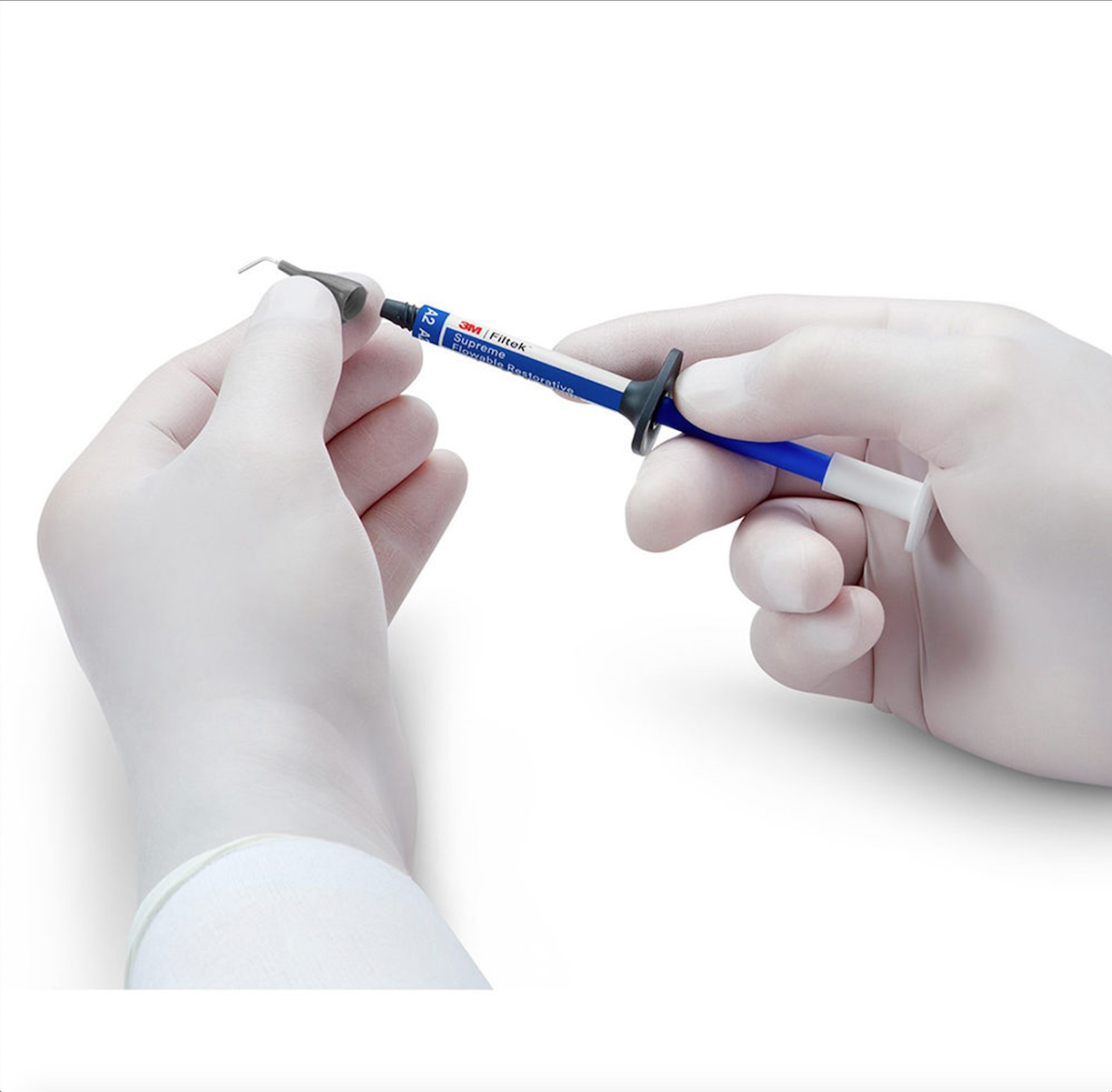
Effective results can be achieved brilliantly with the Filtek Supreme Flowable Restorative, an award winning* composite solution with high strength and wear resistance from 3M. Bubbles are virtually eliminated from your workflows with the introduction of an ergonomic syringe that provides excellent material control,** and creates effective results in a variety of applications. Clinicians can even request a free in-practice or virtual demo to understand how to maximise its potential.
Flowable composites are an essential part of so many workflows, and their excellent ability to adapt to small cavities make them a brilliant tool in the dental arsenal. With ways to minimise complications such as air bubbles, clinicians will long be providing aesthetic restorations with ease, and sending patients home filled with joy.

For more information, call 08705 360 036 or visit www.go.3M.com/ocsdpr
3M and Filtek are trademarks of the 3M Company.
* Dental Advisor award-winning product: https://www.dentaladvisor.com/evaluations/3m-filtek-supreme-flowable-restorative/
** 3M Internal data
Please scan for the:

- Latest news on education, webinars and events
- FREE clinical samples – try before you buy
- Save with current sales promotions
About 3M
At 3M, we apply science in collaborative ways to improve lives daily. With $34.2 billion in sales, our 92,000 employees connect with customers all around the world.
The UK is home to one of the largest 3M subsidiaries outside the USA, employing around 1,900 people across 12 locations, including four manufacturing sites.
Products manufactured in the UK include coated abrasives, personal safety equipment and adhesive tapes.
As a strategic partner of the British Science Association and a sponsor of WeAreTheCity Rising Star Awards in Science and Engineering, 3M is a passionate advocate for diversity, equity and inclusion in STEM (Science, Technology, Engineering and Maths).
Learn more about 3M’s creative solutions to the world’s problems at 3M.co.uk or follow @3MUK on Twitter or 3m.uk on Instagram.
[i] Department of Health & Social Care, (2019). National plan to phase down use of Dental Amalgam in England. (Online) Available at: https://assets.publishing.service.gov.uk/media/5d12135be5274a0698d0b8a4/phasing-down-use-of-dental-amalgam-in-england.pdf
[ii] Abbasi, M. S., Lal, A., Das, G., Salman, F., Akram, A., Ahmed, A. R., … & Ahmed, N. (2022, October). Impact of Social Media on Aesthetic Dentistry: General Practitioners’ Perspectives. In Healthcare (Vol. 10, No. 10, p. 2055). MDPI.
[iii] Baroudi, K., & Rodrigues, J. C. (2015). Flowable resin composites: a systematic review and clinical considerations. Journal of clinical and diagnostic research: JCDR, 9(6), ZE18.
[iv] Baroudi, K., & Rodrigues, J. C. (2015). Flowable resin composites: a systematic review and clinical considerations. Journal of clinical and diagnostic research: JCDR, 9(6), ZE18.
[v] Khaja, M. A., Arani, N., & Vijayalakshmi, D. (2021). Are Flowable Restorative Composites Suitable for Orthodontic Bracket Bonding?. World, 12(4), 334.
[vi] Lassila, L., Säilynoja, E., Prinssi, R., Vallittu, P., & Garoushi, S. (2019). Characterization of a new fiber-reinforced flowable composite. Odontology, 107, 342-352.
[vii] Singh, S., Goel, D., Awasthi, N., Khandelwal, D., Sharma, A., & Patil, S. (2021). Comparative evaluation of marginal integrity of three esthetic restorative materials–An In-vitro study. Contemporary Clinical Dentistry, 12(3), 241.
[viii] Devoto, W., (2020). Bubble-free flowable restoration in estheetic anterior composites. Style Italiano. (Online) Available at: https://www.styleitaliano.org/bubble-free-flowable-restoration-in-esthetic-anterior-composites/ [Accessed December 2023]
[ix] Pain, C. D. (2007). Dental pain. US Pharm, 32(5), 18-23.
[x] Stoetzer, M., Kuehlhorn, C., Ruecker, M., Ziebolz, D., Gellrich, N. C., & von See, C. (2012). Pathophysiology of barodontalgia: a case report and review of the literature. Case reports in dentistry, 2012.
[xi] Dukić, W., Majić, M., Prica, N., & Oreški, I. (2021). Clinical evaluation of flowable composite materials in permanent molars small class I restorations: 3-year double blind clinical study. Materials, 14(15), 4283.
[xii] Devoto, W., (2020). Bubble-free flowable restoration in estheetic anterior composites. Style Italiano. (Online) Available at: https://www.styleitaliano.org/bubble-free-flowable-restoration-in-esthetic-anterior-composites/ [Accessed December 2023]







